Sunday, June 13, 2010

PENNSYLVANIA’S LAUREL HIGHLANDS – SOMERSET, PA

Overnight sites at Hickory Hollow Campground, on the sunny day after we arrived.Leaving Gettysburg, we turned to the west, retracing our route back to the Laurel Highlands of Pennsylvania, the area where the Pennsylvania, West Virginia, and Ohio state lines meet.  We had zoomed through the Highlands a few weeks ago as we made our way quickly from Cincinnati to the Washington, DC area, and wanted to return to spend more time exploring the sights of southeastern PA.

It rained, hard, for most of our travel day – with a break long enough to check in and set up in our site at Hickory Hollow Campground (click here to read our campground review).  We paid for five nights, then sat inside, making lists. 

My list?  All the places I would like to visit while we are here:  the Johnstown Flood Museum, the Flight 93 Memorial site in Shanksville; the Great Allegheny Passage (a rails-to-trails bike/hike path); Frank Lloyd Wright’s Fallingwater and Kentuck Knob homes; nearby Laurel Ridge State Park to see the blooming Mountain Laurel (the state flower); and a search for one of the stones placed by Mason and Dixon when they first surveyed the Mason/Dixon line in 1767.

Odel’s list?  All the minor repairs he wanted to complete before moving on:  fix or toss our expensive water pressure regulator, corroded beyond belief; craft a handle that would allow him to remove the transmission dipstick (the convenient T-handle detached and disappeared somewhere along the way); drain the air tanks; restring one of the day/night shades before it broke completely; clean the carpets.

An item from Laurie’s List: enjoy the blooming Mountain Laurel (and attendant butterfly).

An item from Odel’s list: repair rusted, corroded water pressure regulator

Butterfuly poses on a Mountain Laurel Corroded regulator

It didn’t take long to decide that our combined lists could be more easily accommodated in a week rather than five days.  We liked the park, our good friends Jackie and Buddy were arriving in two days, and the Passport America weekday rate here, for FHU and cable TV, is a major bargain at just $15/night.  We quickly added two more days to our stay, and sent off an email to have our snail mail forwarded here ASAP. 

At the Rockwood trailhead of the Great Allegheny Passage, a former railroad route.We got to work on Odel’s list immediately.  I received emailed instructions on how to fix the pressure regulator, and my determined husband had it working in no time - then worked out a solution for the missing T-handle.  We spent Friday morning restringing the shade, and our friends pulled into the campground just as we finished lunch. 

Segue to Laurie’s list, and everything has been a blur since then.  We’ve walked on the Great Allegheny Passage, visited the Flight 93 Memorial, relived the horror of the Johnstown flood.  We’ve talked and laughed and eaten too much.  I’ve got days of stories for the blog, but no time to write ‘em (yet).  Jackie and I are off to view the Frank Lloyd Wright homes in an hour…

More to come, later!

Wednesday, June 9, 2010

HISTORY COMES ALIVE – GETTYSBURG, PA

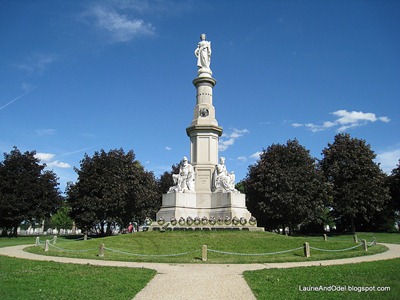
Soldiers Monument, the site of Lincoln's Gettysburg Address History is a sleeper for me – until I am onsite.  With the exception of a few important dates (hmmm, only 1776 and 1962 come to mind at the moment), history is a blur, including the many now historic events of my own lifetime. 

The Civil War is part of the big black hole of “important US history” that is either inaccessible or non-existent in my memory banks. Battalions, brigades, divisions, regiments, all the ranks of military officers… it all is as forgettable to me as domain, kingdom, phylum, class, order, family, genus, species (biology being another mystery to me).  So, when I say Gettysburg knocks me out, you know it’s not coming from a Civil War geek.  If you have even the slightest interest in the Civil War, it likely will knock you out, too.

In case YOU are interested in visiting Gettysburg, here is a summary of what we did, what we considered the highlights, and what we would have done differently.  If your travels take you anywhere near Gettysburg, GO!

A memorial in the woods near Little Round Top Day One: When we checked into Artillery Ridge Camping Resort (click here to read our review), we knew it was close to the battlefield, but didn’t realize it was so close that we could WALK to some of the most interesting battle sites.  That was a huge plus for us.  We would return to this same campground.

We began at the new (2 years old, I think) Gettysburg National Military Park Visitor Center, viewing the orientation film (A New Birth of Freedom, just 22 minutes) and the Gettysburg Cyclorama (se my prior blog post).  It is a great way to begin your education.

Next, we drove most of the battlefield, using the map and driving tour we picked up at the Visitor Center.  It was a simple, relaxing way to see the huge battlefield at our own pace.

Day Two: We walked from our campground into the park, revisiting Little Round Top, Devil’s Den and the Slaughter Pen on foot. 

View to Little Round Top from the Confederate position at Devil's DenThis is one of the two most important battle sites in the park, and even those of us not schooled in military tactics can easily understand the importance of holding the high ground of Little Round Top.  Hand to hand combat, a military blunder by an egotistical military appointee, a forced march through the heat and humidity of July and the valor of troops committed to holding their position at all costs… it is an incredibly heroic story, memorialized with markers, statues, and tablets of all kinds, in all directions.  We walked several miles, but you could walk from the campground to Little Round Top and back in about 2 miles, I think.

Day Three: Our 2 1/2 hour Segway tour covered all the ground we had walked, plus the other “most important” site, the area of Pickett’s Charge and the High Water Mark of the Confederacy.  Along with the Round Top area, the hand-to-hand fighting here marked a crucial point of the battle, when Union troops held Cemetery Ridge and the Confederates withdrew.  On our tour, we heard the recorded narrative of a licensed guide, so learned all the details of both sites, presented with great drama – riveting!

The Wall at High Water Mark, the site of hand-to-hand combat in the struggle to control the ridge.After a rest back at home, we drove through the town of Gettysburg, which we hadn’t even seen yet.  Oh, how I wished we had another day to stay in the area, but our campsite was not available for a longer stay.

Heading back home, we parked in the lot for the Gettysburg Military Cemetery, which encompasses the Soldier’s National Cemetery, burial ground for the Union troops killed at Gettysburg and site of Lincoln’s famous dedication address.  The walk through the cemetery is evocative and sobering, the sense of history overwhelming.  Leaving the cemetery, we walked back through the parking lot, to the west and back to the High Water Mark.  For me, this was the high point of the trip, the crux of the battle.  Envisioning the events described during our tour gave me chills. 

Day Four: Today!  Time to leave.  :(

Three days were not enough – five would have been great.  We had no time to take the historic walking tour of the town, and to enjoy appealing present day Gettysburg.

Odel masters his Segway The Segway tour was great fun – but learning and riding the machine keeps you from focusing fully on the stories playing on your headphones. A tour of some sort is crucial to a real appreciation of the significance of Gettysburg, but I think the open-air, double-decker narrated bus tour would cover more ground while allowing you to give the narration your undivided attention.  I will take it next time we visit.

We were happy with the location of our campground, surely the closest to the sites of greatest interest.  If you go to Gettysburg, be sure you know how to get to your campground without driving through town – I’d hate to drive a big rig through the narrow roads and the roundabout in the center of town.

So, we came, we saw, we learned, we loved it.  See, I just need a field trip to appreciate history.   :)

Monday, June 7, 2010

CROSSING THE MASON/DIXON LINE, TO GETTYSBURG, PA

One of the many, many memorial markers at Gettysburg. Sunday’s travels, a mere 51.5 miles, brought big changes as we crossed the Mason/Dixon line just south of Gettysburg, PA.  Although the line predates the Revolutionary War (click here to read its history), it is most well known as the dividing line between southern slaveholding states and northern free states pre-Civil War, and even now marks the passage from “the South” to “the North”.  After spending the winter in the southern states, we’ve left behind the fried chicken and fried pickles, BBQ pork, greens and gumbo, shrimp, fried catfish, hushpuppies and “meat and three”.  Here, iced tea means unsweetened, and no one asks us obvious Yankees if we want our tea “sweet”. 

To us, the most welcome changes were in our weather and our campsite.  The hot humidity of the past week disappeared as a cooler, dryer front arrived in southern Pennsylvania.  After 9 days of camping in dense forest with 30 amps of electrical power, no water hookup, no sewer hookup, and no cable or satellite TV, we were so ready for our site at Artillery Ridge Campground with full hookups and an unobstructed view of the sky.  As soon as we were settled, the washing machine was chugging away and Odel was busy dumping our holding tanks.  Ah, the luxury of a long shower!

Canon on the ridge overlooking Gettysburg. Gettysburg.  Is there a reader who doesn’t recognize that name?  Nonetheless, due to my inattention in history class, I knew Gettysburg only as yet another Civil War battleground, this one particularly famous because of the eloquence of Lincoln’s address (which Odel begins orating whenever I speak the name Gettysburg) at the dedication of the military cemetery. 

We arrived with no idea of the magnitude of the national park, and no plans other than a reservation for a Segway tour of the battlefield on Tuesday.  To get our bearings, we headed to the National Park Visitor Center yesterday afternoon.

Orientation in the visitor center begins with a 22 minute film highlighting the issues leading up to the war and the significance of the battle at Gettysburg.  After it ended, doors in the back of the theatre opened, leading to escalators moving us upstairs to the Gettysburg Cyclorama (click here to read the interesting details from the NPS site).  Wow!

A scene from the Cyclorama. I’ve never heard of a cyclorama, a not-unusual form of entertainment in those long ago, pre-movie years of the late 1800’s.  Originally completed in 1883, this giant (4 stories high), circular oil painting is one of very few cycloramas remaining (making it an interesting historical artifact on its own).  After a 5 year, $13 million dollar restoration, the Gettysburg Cyclorama opened in its current round building in 2008. 

As we visitors stood on a raised platform in the center of the cyclorama, a narrator described Pickett’s Charge, the final, brutal, bloody battle at Gettysburg.  The lights in the room were dim; spotlights highlighted details of the battle as the narration progressed.  With nothing but narration, music, sound effects and lighting, we were all swept into the heat of the battle, moving from one side of the round platform to another to view the “action”.  Fascinating! 

A house on the battlefield. Thus inspired, we headed out in the car (no air conditioning required!) with a map and driving directions.  We have since driven, walked, and photographed much of the huge battlefield.  The three day battle raged through Gettysburg, the surrounding farms, and up and down valleys and hillsides, now dotted with seemingly hundreds of monuments and markers placed in the late 1800’s.   Yesterday we drove the tour route, today we walked a few miles of it, tomorrow we will take our narrated, guided Segway tour.  Who would have thought it could be so fascinating?